
Key takeaways
- Six aftermarket insole picks that can fit inside stiff, close-fitting Sidi cycling shoes, compared on listed profile, arch shape, and trim or molding options.
What's inside
As an Amazon Associate I earn from qualifying purchases. This post may contain affiliate links at no extra cost to you.
Our top picks at a glance
6 products from this guide, in the order reviewed below.



As an Amazon Associate we earn from qualifying purchases. Prices and availability can change.
Sidi cycling shoes fit close and pedal on a stiff sole, so the best insoles for Sidi cycling shoes are not cycling insoles at all: none of the six verified listings here is made by Sidi or sold for cycling, and each one earns its place on listed profile, trim or molding options, and arch shape alone.
Quick verdict
Start with the Superfeet Run Support High Arch if the shoe is a snug road model, because its listing describes the slimmest build of the six. Choose the SOLE Active Medium if a moldable fit matters more, and read the other four as roomier options for Sidi shoes with depth to spare.
That framing matters more than any single pick. A cycling shoe leaves very little vertical room above the foot, and its stock footbed is usually a thin liner with almost no shaping. An insole that works in a running shoe can crowd a cycling shoe and lift the heel. Every pick below is judged first on the space it takes up, and only then on arch shape.
| Product | Type | Best for | Key spec | Main limit |
|---|---|---|---|---|
| Superfeet Run Support High Arch Insoles | Trim-to-fit running insole | Snug road shoes with a removable liner | EVOLyte carbon fiber stabilizer cap | High arch shape, and a running fit, not a cycling fit |
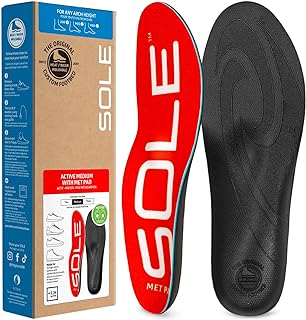
| SOLE Active Medium Insoles with Met Pad | Heat-moldable footbed | Riders who want the arch shaped to their foot | Recycled wine cork base, medium volume cushioning | Medium volume is a lot for a tight road shoe |
| Sof Sole Men’s High Arch Performance Insoles | Full-length foam insole | A stated arch height in larger men’s sizes | Arch height 20 mm as listed, flexible arch | Verified size is men’s 11 to 12.5 only |
| Superfeet All-Purpose Support High Arch Insoles (Green) | Trim-to-fit structured insole | Roomier Sidi shoes with a deep footbed well | High-density foam, trim to fit, model GREEN | Maker aims it at roomy shoes and boots |
| WalkHero Arch Support Insoles | Full-length EVA foam insole | A semi-rigid arch at the plain end of the range | Semi-rigid arch, deep U-shaped heel cup | Maker states no thickness figure |
| PowerStep Pinnacle Work Insoles | Work boot insole | Roomy off-road or commuting shoes only | Neutral arch, dual-layer cushioning | Built for work boots, the bulkiest build here |
| Arch Support Insoles for Work: 12-Hour Comfort for Standing All Day | Arch-support insoles made for standing on the job, marketed for 12-hour comfort. | See the product page for details | See the product page for details | See the product page for details |
How we selected
Every insole in this guide comes from a verified pool built from the products’ own Amazon listing pages, with each page’s title, size and spec table matched to the product before it could be used, and listings flagged for a stock check re-read at writing time before a word was written.
The pool serves insole keywords of many kinds, so the six chosen here were picked for this situation: each states a fit route on its page (sized, trim to fit, or heat moldable), and each publishes at least one profile fact a buyer can compare, such as a listed arch height or a maker description of volume. Two rest on mirror records, flagged in the sources file.
- Listing page opened and matched: title, model and size read from the page
- Profile evidence required: a stated dimension, arch height, or volume wording
- Fit route stated by the maker: sized, trim to fit, or heat moldable
- Health wording left on the listing: features described as the maker describes them
- No cycling claim accepted unless the listing itself makes one, and none does
The best insoles for Sidi cycling shoes, one by one
The six footbeds below are ordered by how plausibly their listed build fits inside a close cycling shoe, from the slimmest running design to a work boot insole included only for the roomiest shoes. Where a listing states no thickness, the section says so instead of estimating one.
Superfeet Run Support High Arch Insoles
The Superfeet Run Support High Arch is the natural starting point for a snug Sidi road shoe: it is a running insole whose listing describes a slimmer heel and arch length than the maker’s standard shapes, with a carbon fiber stabilizer cap under the arch instead of a thick foam stack.
Who it is for: riders whose Sidi shoes have a removable liner and very little spare depth, and who want arch shape without adding much height. The verified listing is the men’s 5.5 to 7 and women’s 6.5 to 8 size, in the Citron colorway, with a nylon and polyester build. The maker’s feature list names a deep heel cup, an EVOLyte carbon fiber stabilizer cap, a heel impact pod, AeroSpring Rebound dual comfort foam, and a MoistureWick top cover. The line is trim to fit, so the outline can be cut down against the Sidi liner.
The limits are real. The arch is a high arch shape, and a rider with low arches may feel it as a lump under the midfoot. It is still a running insole, shaped for a shoe that flexes, and nothing on its page speaks to a rigid cycling sole.
- Pros: slimmest listed build of the six, with a carbon fiber cap
- Pros: trim-to-fit outline follows the shoe’s own liner
- Cons: high arch contour will not suit low arches
- Cons: no cycling shaping or cleat guidance on the page
Buy if your Sidi pair is a close road model and you want the least bulky structured option here. Skip if your arches are low, or the shoe has no removable liner.
SOLE Active Medium Insoles with Met Pad
The SOLE Active Medium is the only pick that is molded to the rider’s own foot: the maker describes a heat-moldable base of recycled wine cork, medium volume Softec cushioning, a moisture-wicking topsheet with a Polygiene treatment, and a built-in metatarsal pad on this version.
Who it is for: riders who find fixed arch contours wrong in one spot or another and would rather shape the support themselves. The molding routine is stated on the page: an oven at 200 degrees Fahrenheit for two minutes, then the footbeds go into the shoes and the rider stands in a neutral position for two minutes. For the crawled men’s 10 size, the page lists a forefoot width of about 98 millimeters and a heel-to-toe length of about 290 millimeters, two real numbers to set against a Sidi liner. The line is sold in Regular, Wide and Met Pad styles.
The limits: medium volume is the maker’s middle setting, and in a tight road shoe it can still be too much material, raising the foot so the heel no longer sits where the shoe expects it. Molding takes an oven and a few careful minutes, and a footbed molded in a poor stance keeps that shape.
- Pros: heat molding shapes the arch to the individual foot
- Pros: forefoot width and length stated in millimeters
- Cons: medium volume can crowd a tight road shoe
- Cons: oven fitting needed before use
Buy if you want to shape the arch yourself and your Sidi shoes are a regular or roomy fit. Skip if the shoe is a narrow race model, or you want a drop-in footbed.
Sof Sole Men’s High Arch Performance Insoles
Sof Sole’s High Arch Performance is a full-length foam insole with the most precisely stated arch in this guide: the listing’s own spec table gives an arch height of 20 millimeters, a flexible arch support type, and item dimensions of 0.21 by 4.1 by 11.8 inches.
Who it is for: men in the larger sizes whose Sidi shoes feel flat under the arch and who want a number, not a description, before buying. The verified listing is the men’s 11 to 12.5 size in gray, with a foam build, an item weight of 0.31 pounds, and listed uses of walking, running and everyday use. A stated arch height is rare in this category: the arch here is shaped but flexible, so it gives under load rather than holding a rigid line.
The limits start with sizing: the verified listing covers men’s 11 to 12.5 only. A 20 millimeter arch is a strong shape for a foot that does not want one, and a flexible foam arch will not hold its height the way a capped design does.
- Pros: arch height and dimensions stated on the listing
- Pros: flexible foam build with a thin listed edge
- Cons: verified size is men’s 11 to 12.5 only
- Cons: foam arch gives less hold than a rigid shell
Buy if you wear the larger men’s sizes and want the arch height printed before you commit. Skip if your size falls outside the verified listing.
Superfeet All-Purpose Support High Arch Insoles (Green)
The Green is Superfeet’s firm, structured footbed: a trim-to-fit insole built on high-density foam, with a sculpted heel cup and a polyester material line in the spec table, sold under the model name GREEN and formerly known by that color name alone.
Who it is for: riders whose Sidi shoes are the roomier kind, such as off-road models with a deep footbed well and a liner that lifts out cleanly. The verified listing is the men’s 7.5 to 9 and women’s 8.5 to 10 size. The maker’s bullets describe firm underfoot cushioning for high arches and a heel cup that cradles the heel, and the maker rates the shape at up to 12 months or 500 miles. Because it is trim to fit, its outline follows the liner.
The limits are stated by the maker itself: the trim guidance on the page speaks of roomy shoes and boots, and this is the fullest structured build in the guide. In a snug road shoe it will likely lift the foot high enough to spoil the heel hold. Trimming is also permanent.
- Pros: firm high-density foam keeps its shape under the arch
- Pros: trim-to-fit length follows the shoe itself
- Cons: fullest structured build here, aimed at roomy footwear
- Cons: high arch contour will not suit low arches
Buy if your Sidi shoes have real depth and you want structure that holds its shape. Skip if the shoe is a close road model.
WalkHero Arch Support Insoles
WalkHero’s entry is a full-length EVA foam insole with a semi-rigid arch and a deep U-shaped heel cup, model number Insoles-044_06_Gray in the captured listing, and it reaches this guide as the plain, firm option for a roomier cycling shoe. Its semi-rigid arch is the feature the whole comparison turns on for this pick.
Who it is for: riders who want a shaped arch and a deep heel cup in a shoe with volume to spare, such as a commuting or off-road Sidi model. The maker describes the arch as semi-rigid, which places it between the flexible Sof Sole foam and the capped Superfeet designs: it holds a line under the midfoot instead of folding. The heel cup is the feature a cyclist can use, since a deep cup keeps the heel seated when the foot pulls up through the pedal stroke.
The limits are mostly about information. The captured listing fields state no thickness, no weight and no dimensions, so a buyer cannot compare its volume on paper against the other five, and in a shoe where millimeters decide the fit that is a genuine drawback.
- Pros: semi-rigid arch holds its line under load
- Pros: deep U-shaped heel cup for heel seating
- Cons: no thickness or dimensions stated
- Cons: full-length rigid build needs a roomy shoe
Buy if your cycling shoes are roomy and you want a firm arch with a deep heel cup. Skip if the shoe is snug, or you need published dimensions.
PowerStep Pinnacle Work Insoles
The Pinnacle Work is a work boot insole, and it is included with that label in plain view: a full-length footbed with built-in neutral arch support and dual-layer cushioning, an odor control top fabric, and the model name Pinnacle Work in a black and yellow colorway.
Who it is for: riders whose cycling shoes are the roomiest kind, such as off-road or winter models with a deep, flat footbed well, and who want a neutral arch rather than a high one. The maker describes the top fabric as helping control heat, friction and perspiration, and the dual-layer cushioning is the softest arrangement here. In a loose shoe, that bulk is the point: it takes up space a thin liner leaves empty.
The limits follow from the design brief. This footbed was shaped for work boots, not for a tapered cycling last, so its outline may need heavy trimming and its height can lift the heel out of a shoe that was already marginal.
- Pros: neutral arch suits feet that dislike a high contour
- Pros: dual-layer cushioning fills a deep footbed well
- Cons: work boot build is the bulkiest of the six
- Cons: outline is shaped for boots, not cycling shoes
Buy if the cycling shoe is genuinely roomy and you want a neutral arch with real bulk. Skip if the shoe is a road model of any kind.
Buying guide
An insole change inside a cycling shoe is a volume problem before it is a support problem, so the decisions below run in that order: measure the space, pick the slimmest build that still adds shape, fit it against the liner that came out, and only then judge the arch.
Start with the liner that is already in the shoe
Every pick in this guide is a replacement, not an addition: the stock Sidi liner comes out first, and the new footbed takes its place on the shoe’s lasting board, which is why the thickness of the liner you remove is the first number worth knowing before anything is cut.
Lay the removed liner on top of the new insole before trimming anything. The outline shows where the cycling last is narrower than a running shoe, usually at the midfoot and the toe, and the side profile shows how much height the swap adds. Keep the stock liners: they are the template for trimming.
What the best insoles for Sidi cycling shoes have in common
The picks that suit a close cycling shoe share three traits: a stated or describable profile, a fit route that lets the buyer adjust the outline, and an arch shape that adds support without adding a thick stack of foam under the whole foot. Those three traits are the filter the rest of this guide applies.
Volume is the trait that rules the others out. A stiff cycling sole does not flex around a thick footbed the way a running shoe does, so extra material has nowhere to go: it raises the foot, and the heel counter, toe box and closure all lose their fit. That is why this guide orders the six from the slimmest build to the bulkiest.
Trimming and molding, in the makers’ own terms
Two of the six are trim to fit and one is heat moldable, and both routes exist to solve the same problem: the insole should match the shoe you own, including a tapered cycling last, rather than the size printed on a chart. Neither route needs tools beyond scissors or a home oven.
For a trim-to-fit pair, the maker routine is to trace the removed liner, cut outside the line first, and test the fit before taking more off, because material removed cannot be put back. Cut the toe end, and take slivers from the widest point if the footbed buckles. For the moldable SOLE footbed, follow the maker’s routine exactly: an oven at 200 degrees Fahrenheit, two minutes of heating, then two minutes standing in the shoes.
Arch height is a listed number, not a feeling
Only one listing in this guide prints an arch height, 20 millimeters for the Sof Sole, and the rest describe their contours in words such as high arch, neutral arch or semi-rigid, which cannot be compared across brands with any precision. The words are not interchangeable between brands.
Read those words as each maker’s internal scale, not as a shared unit. A high arch from one maker can sit lower than a neutral arch from another, and the only honest comparisons are the printed ones: a stated arch height, a stated dimension, or a volume word from the maker’s own range. A high contour under a low arch is a pressure point, not a support.
When the problem is the foot, not the shoe
A footbed can change how a shoe holds the foot, but it cannot correct a foot, and persistent pain on the bike is a question for a professional rather than for a different insole from a list like this one. Swelling, numbness and pain that lingers off the bike all belong in that conversation, not in a product comparison.
Feet change volume across a long ride and across a season, and a small change is normal. A persistent change is different. If pain persists, if one foot swells more than the other, or if numbness keeps returning in the same place, ask a doctor or a foot specialist about it rather than swapping insoles again.
FAQ
Most questions about insoles for Sidi shoes come down to one honest fact, that no maker in this guide sells an insole for cycling shoes, so the answers below stay with what the listings state and with the geometry of a stiff, close-fitting shoe. Nothing here rests on a claim the listings do not make.
Are any of these insoles made by Sidi?
No. None of the six is a Sidi product, and none of the six listings names cycling shoes among its uses: the set is two running insoles, one moldable everyday footbed, one general foam insole, one arch support insole and one work boot insole. Every one is a general insole from another category.
That gap is the honest starting point for this keyword. Sidi’s own shoes ship with the maker’s own footbed, and the six here are aftermarket substitutes judged on profile and fit route alone. If a listing does not state a fact a rider needs, this guide says so rather than guessing.
Will a running insole work in a cycling shoe?
It can, within limits: a running insole is shaped for a shoe that bends, while a cycling shoe barely bends at all, so what transfers is the arch shape and the heel cup, not the cushioning behavior the running listing describes. The heel cup is the part that matters most on the upstroke.
The fit question decides it in practice. A trim-to-fit running insole can be cut against the cycling shoe’s own liner and will sit flat if the shoe has the depth for it. Where it cannot work is volume: a thick footbed in a snug road shoe raises the foot until the heel slips.
Which of these adds the least height inside the shoe?
On the printed figures alone, the Sof Sole lists the thinnest edge dimension, 0.21 inches among its item dimensions, while the Superfeet Run Support is described by its maker as the slimmer of its running shapes; the other four listings state no comparable figure.
That answer comes with a warning: item dimensions can describe packaging as easily as the product, and makers measure thickness at different points, so the figures are a starting point rather than a verdict. The reliable test is the liner swap: new footbed in, stock liner out, shoe closed, and a short ride before deciding.
Can I trim an insole to fit a narrow cycling last?
Yes, for the trim-to-fit models: both Superfeet listings are made to be cut down, and the routine is to trace the liner that came out of the shoe, cut outside the line, and take more off in small passes until the footbed lies flat. The moldable pick is shaped by heat instead of scissors.
Trim the toe end and the widest point of the forefoot, and leave the arch and heel sections alone, since that is where the maker’s shaping lives. A footbed that buckles at the sides is too wide, not too long, and a sliver off the edge fixes it better than a shorter cut.
What if the new insole makes my heel slip?
Heel slip after a swap almost always means the footbed is too tall for the shoe: the foot now sits above the part of the heel counter shaped to hold it, so the heel moves on every upstroke no matter how firmly the shoe is closed. It is a height problem before it is a closure problem.
The fix is a slimmer footbed, not a tighter closure. Move down this guide’s order, from the moldable or structured builds toward the thinnest listed option, and compare the stock liner beside the new one to see how much height the swap added.
Arch Support Insoles for Work: 12-Hour Comfort for Standing All Day
Arch-support insoles made for standing on the job, marketed for 12-hour comfort. View on Amazon.
Conclusion
For a snug Sidi road shoe, take the Superfeet Run Support for its slimmer listed build; for a shaped fit, mold the SOLE Active Medium; and keep the Green, the WalkHero and the Pinnacle Work for shoes with real depth, where their bulk is a feature instead of a fault. Fit, in the end, is decided by the room inside the shoe.
Whichever of the six you choose, swap it in place of the stock liner, trim or mold it against that liner, and judge it over a full ride rather than a first pedal stroke. An insole cannot add room the shoe does not have.
Related guides
More from Amazon
Programs that pair well with the guide above. Offers and eligibility are set by Amazon and may change.
Free shipping on eligible items, Prime Video and more. Eligible new members can start with a free trial.
Start a Prime free trialA Prime membership for ages 18-24 with a trial period. Eligibility is set by Amazon.
See Prime for Young AdultsAudiobooks and podcasts to listen to on the go. Eligible new members can start with a free trial.
Try Audible freeAd-free music streaming. Eligible new subscribers can start with a free trial.
Try Music Unlimited freeAs an Amazon Associate we earn from qualifying purchases.

Write Your Review
No reviews yet. Be the first to share your experience!